Monday, 18 March 2013

I Hear bout U Everywhere I Go!


In this week’s blog I am going to continue to write about how I think politics and the social media have become more entwined with each other in the sense of how easy, it is to be up-to-date with political news today.

In the manner we live today where everything is most often a click of a mouse away; the world has become much easier for us to be sync with the rest of the world and the daily news from across the global.  A major part of our lives which we like to admit it or not is politics. The reasons why we do certain things in our lives today are because of what the government officials, have allowed us to do or the laws they make in order for us to live like we do. Clearly enough most of us would like to stay in-touch with what happens in the world today and no-other news comes bigger than politics I feel.

In the past humans resorted to reading the newspaper in-order to be aware of what was going on around them and other things etc. Then the use of a radio became much easier to use as the presenters on the radio would just read out what interest stories had happened. Then the TV also was another source of information as, the television offered us news as well as visual image this became one of the most popular sources of information along with the newspaper. People going to work sitting on the tube or, on the bus couldn’t watch television on it, till one or two years ago so the newspaper seemed to be still, very useful in handy in the sense that you can read it wherever you may be.  So now we have reached an era where, searching news out on your mobile phones had become a better easier than buy a newspaper and having to flick through it all to find the news you wanted to know.

But now as our newspapers, television channels and radio stations gave us option and preference to what we actually enjoyed reading or listening so does the, option of download an app for your smartphones to allow you to be informed of the news around the world. We have evolved once again to reading news not from the paper though, from our mobile phones which saves us from buying the paper. We as humans like to do things that make it much simpler for us to live our life’s, and allow us to avoid things that may cause us to struggle obviously. With the newspaper it can be a hassle trying to read it on the bus or train especially if you haven’t got a seat or space to open it up and start reading it. Also it can be annoying when you have the sense of feeling that someone is reading over your shoulder which seems too happened a lot, when sitting on public transportation. Also if you are reading the paper outdoors and it starts to rain, the newspaper obviously cannot escape the fact that it will become ruined and no longer useful.

The mobile phone is our own personal device which people tend not to look at when you are on transportation that is public. Save you from buy the paper as it would kind of be more convenient for certain people, rather than carrying a newspaper around with you all day. Also could help prevent global warming as you’re less likely to buy the paper and then throw it away without recycling it.

To sum up what this blog was about is that the source of our information is slowly adapting for us to make it easier for us to receive it and keep us in touch with news, virtually from anywhere with internet access in the world.

See What Is Physically Not There!


In this week’s blog I am going to talk about how the world is evolving in to virtue news that can be viewed and operated by with our own current mobile phones. Augmented technology is claiming to be the future of how we read or view things in the world today so, I'm going to see if that is the case and how relevant the technology is to us.
In this day and age so far augmented reality is merely just a concept of how we will view the news and maybe stream videos sometime in the future. Right now newspapers and the internet are the fast way of finding out news or information about things the concern us, also considering the television as well. So far these technologies I speak of have been relatively good to us for some years now so, to speak of something that might surpass easiness of the use of the newspaper and maybe even searching online seems to be unheard of till now. Here’s a brief video of just what some augmented realities have to offer:


You can clearly see in the video above just how easy and convenient the technology could serve to be for us especially as, we can be able to start using it from our current mobile phones now. When things are very simple and clear to use the more likely everyone will be expected to also use it too, due to the good reviews obviously been given to it from others. But viewing this video you’re most likely thinking that this technology won’t be available for at least another two to three years but that’s where you’re wrong. Augmented reality is slowly starting to develop now as we speak and the early signs of life are, slowly creeping through.


Aurasma is a company that develops augmented reality currently and has one of its software’s, Auras actually available for download in the app store and, in the android market. For more information on what the application does and more about the company take a look at their website: http://www.aurasma.com/aura/. If you have a smartphone download the app for yourself and test out exactly what the application does for you and what you feel about it. And if you like it tell a friend to start the viral trend flowing, so you know what going on and aren’t left behind. 


Wednesday, 6 March 2013

Digital Politics


In this week’s blog I am going to blog about how the digital world is slowly becoming integrated with politics and how it affects the public today. I’ll start of by explaining what I mean when I say the digital world is becoming integrated with politics which is; Politicians know that by using various medias such as, television, radio and even the web to broadcast their messages out it is much more likely people will watch them or listen to them. So as time moves along becoming more technological and simplified, politics is also finding its way to adapt to the changes which the world is finding itself to be in.

‘On 26 September 1960, 70 million U.S. viewers tuned in to watch Senator John Kennedy of Massachusetts and Vice President Richard Nixon in the first-ever televised presidential debate. It was the first of four televised "Great Debates" between Kennedy and Nixon. The first debate centered on domestic issues.’-reference from: www.museum.tv/. JFK and Nixon exposed the world to a new way of including politics to the lives of the public without them even leaving their own house, to find out what is going on. The so called “Great Debates” happened to be very influential in the US I say this because ‘John F. Kennedy was a relatively unknown senator from Massachusetts. He was young and Catholic — neither of which helped his image — and facing off against an incumbent. But by the end of the evening, he was a star.’ -Read more: http://www.time.com/time/nation/article/0,8599,2021078,00.html.

It is very clear that television has become an important tool for politicians today but, unlike the 1960s JFK proved himself to be a great character and president by using the television form of media, but in today’s world there are so many other ways that MP and the PM have to present themselves to be a worth leader.  In October 2012 British Prime Minister David Cameron opened up an account on the social networking site called, twitter. I doubt he actually wanted to open up the account himself but, obviously his P.R. manager that it would be a good idea to show the country that he is with the current times of technology. ‘The Tory leader clocked up more than 50,000 followers within hours of his debut, but was following just four other posters – the Conservative party, William Hague, Boris Johnson and Jeremy Hunt. ’ But although he had received more than an I quote ’50,000 followers’ he then was presented with the other side of having too many people following you.  David Cameron has signed up to Twitter, prompting users of the social networking site to inundate him with hundreds of hostile messages.’-Reference from: http://www.guardian.co.uk/politics/2012/oct/07/david-cameron-joins-twitter.

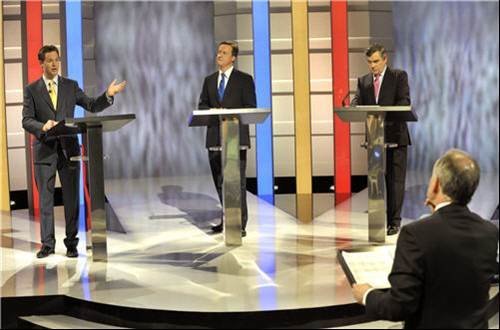
In the UK, the 2010 general election was the first ever time the three main parties in the UK consisting of Labour party represented by then Prime Minister Gordon Brown, Conservatives represented by David Cameron and, Liberal Democrats leader Nick Clegg also representing his party. This was the first time ever parties in the UK had ever had the chance to go toe to toe with each other on television in the run-up before votes were casts. This was just as major and influential as JFK’s first television debate was as; Nick Clegg was also a relatively unknown name as well before emerging on the scene in 2010 taking over from former Lib Dem leader, Vince Cable. ‘Gordon Brown tended towards waffle and repetition, often seeking refuge in reams of statistics; and Nick Clegg sought to appear relaxed, confident and the voice of sweet reason, playing the other two against each other – with some success, it must be said. In terms of policy, we learned little that we did not know already. Mr Brown was weak on immigration, unconvincing on crime and perversely thinks he has a strong hand to play on the economy, despite presiding over the country's worst ever deficit. Mr Clegg had the advantage of leading a party that has not been in government for 80 years, so could not be blamed for the mistakes of the past.’-Reference: http://www.telegraph.co.uk/news/election-2010/7595960/Election-2010-Clegg-uses-first-TV-debate-to-best-effect.html

It’s clear to see that the television debate also was useful here as well, the media and public all gave Nick Clegg positive responses other than the David Cameron and definitely Gordon Brown. Politics and the media are definitely a major force in the world, and will always use the media to spread their messages to the whole world.

Wednesday, 27 February 2013

Do you really need this?


In this week’s blog I am going to talk about the topic that was discussed in the workshop and just another summary of how I feel about, social networking sites and how I use them. In the digital cultures workshop we had a little bit of a discussion about how we personal feel about how our friends, and people we know go about using social networking sites such as; Facebook, twitter and even, instagram.

I currently only use one social networking site which is Facebook, when I was younger I was into following the trend of having multiple social webpages where, I just used to upload pictures of myself, songs that I liked and my close friends where given a shout out. When I think back now of the websites I used to use, I see there was really no point of having one of them as the networking capabilities were no as impressive as they are today. Also the fact that you couldn’t actual make connect by having friends, to make it easier to communicate made hard, as I used to write down their websites rather than a link on my page to take me straight there.

I may sound like an old retired veteran in saying this but it’s the honest truth when I say that I’ve experienced it all in the past so, that may justify the reason to maybe why I only used Facebook now instead of using so many different social networking sites like; twitter and instagram etc. I have even become bored of Facebook’s antics which when I first started using it became amazed by how, connected everyone was and seeing nearly everyone’s posts on one page, definitely beat having to check through tons of other peoples websites to just to check an update.

Another reason why I don’t like social networking sites no more is because of the fact that they have become way to personal these days. Before all you really needed were your email address and your name and maybe even you D.O.B. But now you need to agree to the website’s bible full of rules and regulations which you clearly know you aren’t going to read.  The fact that your pictures do not even belong to any longer once you’ve uploaded them to a website is a big turn off for me personally. There is so much to think about before clicking the accept box but, we neglect from doing so because we just aren’t used to have to do it, like we did in the past. All social networking sites are coming to a point when they are becoming truly irrelevant anyways, when the majority of time people just update status by saying ‘I’m bored’ or ‘I’m having dinner now’. Just because you can write about it, it doesn’t mean you should. And even now on instagram people have shifted from writing about what they are eating or doing to now, taking a picture of it and uploading it for everyone to see. I definitely don’t see the point of doing that so I don’t see the reason of signing up to that.

To conclude I feel that social networking site are only really useful if your using it to keep in touch with friends and long distance family, they become really useful when doing group work and you want to contact all members at once. But for everyday use and reading what people are literally doing at the moment, social networking sites become a huge turn off to me.

Wednesday, 20 February 2013

Divide and Conquer


In this week’s blog I am going to write about Globalization and Digital divide and just what it means in across our world today. Firstly I am going to define what the two terms mean;

Globalization- Is the process of international integration arising from the interchange of world views, products, ideas, and other aspects of culture-
Reference from: http://en.wikipedia.org/wiki/Globalization

Digital Divide- A digital divide is an economic inequality between groups, broadly construed, in terms of access to, use of, or knowledge of information and communication technologies (ICT). The divide inside countries (such as the digital divide in the United States) can refer to inequalities between individuals, households, businesses, and geographic areas at different socioeconomic and other demographic levels, while the Global digital divide designates countries as the units of analysis and examines the divide between developing and developed countries on an international scale.
Reference from: http://en.wikipedia.org/wiki/Digital_divide

From my understanding globalization and digital divide is when certain countries or even continents are more equipped and much more progressive then others for example: the United States is clearly much more digitally developed than Ethiopia is. I say this because more households in America are more likely to have a computer in the house with internet, than households in Ethiopia. The reason why I chose a reference from Wikipedia to define what digital divide means is because; it has different meanings across the global. Like explained in the reference for a country like the US digital divide could refer to peoples’ households’ i.e. different internet speeds, PC brand, costs etc.  

As you can notice poverty seems to be the main aspect of globalization which causes the digital divide to occur across the world today. Depending on where you are or live you will be affected by this either in a good way; by being able to use the internet or, in a bad way; either no access to internet or technology which is probably outdated. This is bad news as the developing countries across the world will always be one step behind those who are leading the way. Even if they pushed to close the gap between those developed countries it will either cost money which they may not have or, require training for a period of time as well as support from those who already know what to do.

In the world today the use of computers and working on the World Wide Web is a very relevant thing to have, and as some countries are still without one or the other it makes it very difficult for their country to develop. This in turn continues to create a globalization which as we know now continues to create a big gap between rich and poor countries. Its’ very clear to see that across the world today technology isn’t evenly spread out on the map, so access to information, technology and even forms of communications are obviously not going to be easy to get their hands on in a less developed country.

I think that globalization and digital divide are two factors that are always going to be present, as its presence in the world today is very clear to see and frankly not so easy to get rid of. I also think that the divide is something that will always occur not just across the world but internally in countries also, due to there being different classes, cultures and usage of the technology equipped. But on solving the problem across the world, poverty is clearly the main factor behind this digital divide and creates a globalization of it which makes it much harder to cure. So we should donate and help more in order for the development of, undeveloped countries to receive the educating they need to and receive the technology they need in order to progress. 

Tuesday, 12 February 2013

Call Of Duty 9: Digital Blogging-fare


  In this week’s blog I am going to talk about the concept of flow and how it is effective in playing video games.  As usual in my blogs I’ll start of by explaining what the main topic is of the week is. The concept of flow is ‘the mental state of operation in which a person performing an activity is fully immersed in a feeling of energized focus, full involvement, and enjoyment in the process of activity.’- Reference from http://en.wikipedia.org/wiki/Flow_(psychology). The concept is further explained as being ‘In essence, flow is characterized by complete absorption in what one does. Proposed by Mihály Csíkszentmihályi, the positive psychology concept has been widely referenced across a variety of fields’.  

The concept of flow easily falls into place when talking about the use of video games and the effect it has on the players whilst playing. I find it that people necessarily like to be challenged but also want to enjoy themselves at the same time too so, the perfect incision to missing spot is video games. We go through a lot of different emotions and moods when playing games and, we most often take the outcome seriously even though we know it is just a game.  Like Gavin Stewart pointed out ‘Whilst playing a game of FIFA we tend to say we or I scored a goal. But when a chance is missed in the game, we straight away single out the player to distance ourselves away from that player, although we are still in control’.

Mihály Csíkszentmihályi is a Hungarian psychology professor, who moved to the United States when he was 22 years old. He is the man behind the concept and expresses the idea fully in a video on www.ted.com.  


The video is great as Mihaly himself explains exactly what he means from his own mouth so you have a greater understanding of the concept of flow rather, than just reading it from a book. The diagram representation of the flow, gives a clear interpretation on exactly what Mihaly Csikszentmihalyi means. I also found more information on the subject on the internet where Mihaly Csikzentmihalyi and Jeanne Nakamura, go into detail about the concept of flow and supports the claims with some analysis: 
http://myweb.stedwards.edu/michaelo/2349/paper1/ConceptOfFlow.pdf

Wednesday, 6 February 2013

University of sims 1,2&3


In this week’s blog I am going to discuss the meaning of gamification and how we can inject it into our normal life to make it more rewarding and, less boring. Firstly I am going to explain the meaning of gamification and how we as humans, include it in our everyday lives unknowingly.

Gamification basically means ‘applying game design thinking to non-game applications to make them more fun and engaging.’-Reference from http://gamification.org/wiki/Gamification. Now I can think of many times in my life were I’ve made a game out of nothing in many different places for example; Walking in the street and trying to overtake someone ahead of me, avoiding certain tiles on the floor in a corridor and even, seeing the same car more than once on the road.   I’m sure there is hundreds of other games I used to play and thousands more people used to play all over the world. My point is, we use these games to bypass the day and disconnect yourself from the world for a small amount of time that, we do for most our life.  The need of being instantly rewarded for achieving a goal or a task we set that has been set out for us reminds me of how video games work. Video games can be very stress relieving as they tend to have objectives, placed that are to be completed and when they are completed; immediately rewards the player for the quest he/she just accomplished.

So with that in mind I think of how gamification can be added in to school systems in the country and then to see if it actually could work. Being instantly rewarded for attending class, or doing your homework would seem like a much better system for student that don’t have the motivation to go into lessons. You can’t always blame students for not always wanting to come to school, we’ve all had the moment when we just do want to go into work or school. Our Morales drop incredibly low and for students like myself, go into school/university and sitting in a boring lesson not taking anything in, you then question yourself on why you even bothered. But for example; Lets just say during the lesson you attempted to answer 5 questions that were put forward to the class. And as a reward for attending plus, participating in the class you receive a cash prize at the end  of the day I would definitely become more encouraged in attending lesson, even if they are                 still extremely boring. The fact of the matter is we all enjoy being immediately noted for completing something.
If schools could possible find a way of letting the pupils know that their education doesn’t have to be so boring and tamed, and also that becoming more creative and, different would draw people into the whole idea of having fun whilst being educated. In a workshop this we all discovered that we became very engaged in a theses discussions and our lecture pointed out that ‘it had been the first time this year the class were fully focussed on the task and had smiles on our faces, on a Tuesday morning! So I think it doesn’t even have to be money that the students are rewarded with for attending class, it could be; a point system and if you save up your points that you receive for each attended lesson you can use the points to purchase books for your course or even all types of equipment for your course or, just in general. Because school shouldn’t be something you just turn up to and hope you’re not bored to death, but we should receive education in a more engaging method and I think Gamification has something that could just work out for school systems that are government funded or universities.